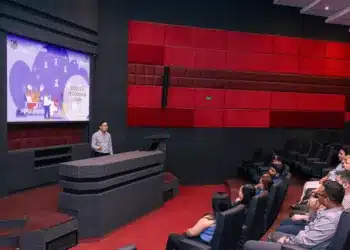


Stuart Harrison, CEO of Emrill, one of the UAE’s most established integrated FM providers, is direct on this point. “Continuity in FM is ultimately delivered by people,” he says. “Ensuring they are supported, trained and able to adapt is fundamental to maintaining performance.”
For Emrill, cross-training and skills development are not crisis-response tools — they are embedded into everyday operations. Through the company’s Centre of Excellence, employees are equipped to work across multiple functions, giving the organisation the flexibility to maintain service delivery even when external factors affect recruitment, onboarding, or workforce availability. The result, Harrison explains, is a workforce that can adapt without the operational structure needing to shift dramatically.
But workforce continuity extends beyond capability. It requires wellbeing. FM is physically demanding, often unglamorous work, and periods of uncertainty — regional tension, public health scares, economic anxiety — place real psychological pressure on frontline teams. Emrill’s response has been concrete. “Our ‘A Better You’ programme provides employees and their families with access to confidential counselling and wellbeing resources,” Harrison says, noting that engagement with the programme has risen sharply in recent months. “Counselling sessions have risen by over 230% and there has been a notable increase in employees proactively seeking support for anxiety and stress-related concerns.”
Keeping the Supply Chain Moving
Harrison describes Emrill’s approach as one of relationship depth rather than defensive overstocking. “Our approach is centred on strong supplier relationships, diversified sourcing strategies and careful inventory management. Rather than overstocking, we focus on maintaining essential levels of critical consumables, ensuring materials are available when needed without placing unnecessary pressure on supply networks.” When disruption does occur, the company has adapted logistics strategies accordingly, with alternative sourcing routes activated and close supplier collaboration enabling faster response.
Consistency, Not Reinvention
One of the more counterintuitive insights to emerge from speaking with FM leaders is that effective continuity planning is less about having an elaborate emergency response mechanism and more about the quality of normal operations.
Harrison frames this with precision: “Continuity is not driven by change, but by consistency. We do not introduce entirely new ways of working in response to external events. Instead, we reinforce the proven systems already in place, ensuring they remain effective under pressure.”
This principle has practical implications. When escalating conditions prompt clients to look to their FM partners for reassurance, the response should not be a scramble to implement crisis measures never previously tested. It should be evidence of systems that were already working — and continue to work. For Emrill, this has meant increasing leadership presence across sites, more frequent engagement between managers and frontline teams, and reinforcing communication structures that were already established.
The soft FM dimension of this is particularly telling. “In soft FM, maintaining a sense of normality is essential,” Harrison notes. “Visible disruption can create uncertainty, particularly in environments with high occupancy or public access.” Operational changes in service patterns — for example, the increased cleaning frequencies introduced in response to higher residential amenity use as occupancy patterns shifted — were achieved by adapting within existing frameworks, not by overhauling operations from scratch.
Technology as an Enabler
No discussion of modern business continuity planning would be complete without addressing the role of technology — both as an enabler of resilience and as a potential source of vulnerability.
For FM providers managing large, geographically dispersed portfolios, digital platforms are increasingly central to workforce communication, asset management, service tracking, and operational visibility. Harrison is clear that technology investment must be accompanied by robust protection. “We have increased our focus on cybersecurity and system monitoring, with more checks enabling faster identification and response to potential risks,” he says. “Our business continuity and disaster recovery plans are well established and regularly tested.”
Digital communication infrastructure also plays a direct role in workforce continuity. The ability to push consistent guidance and operational updates to teams across dozens of sites simultaneously — ensuring that every supervisor is working from the same information — is an underrated but significant continuity asset.
From Plans to Practice
The best FM continuity plans in the region are those that are owned by operational teams, not just compliance departments. They are calibrated to the specific characteristics of each site, the profile of its occupants, and the relative criticality of different service lines.
“Continuity in FM is defined by the ability to operate without disruption, regardless of external conditions,” Harrison says. “At Emrill, this is achieved through clear processes, operational discipline and a key focus on people, collaboration, continuous improvement, performance and delivery.”
You may also like
-

Emrill outsources fleet to Hertz
UAE-based facilities management service provider Emrill has outsourced the management of its 127 vehicles to fleet management specialist, Hertz
September 18, 2019